Urban City Stories: World Game
- 4.5
- Rating
- 50.00M
- Installs
- Free
- Price

 Analysis by App-foxy
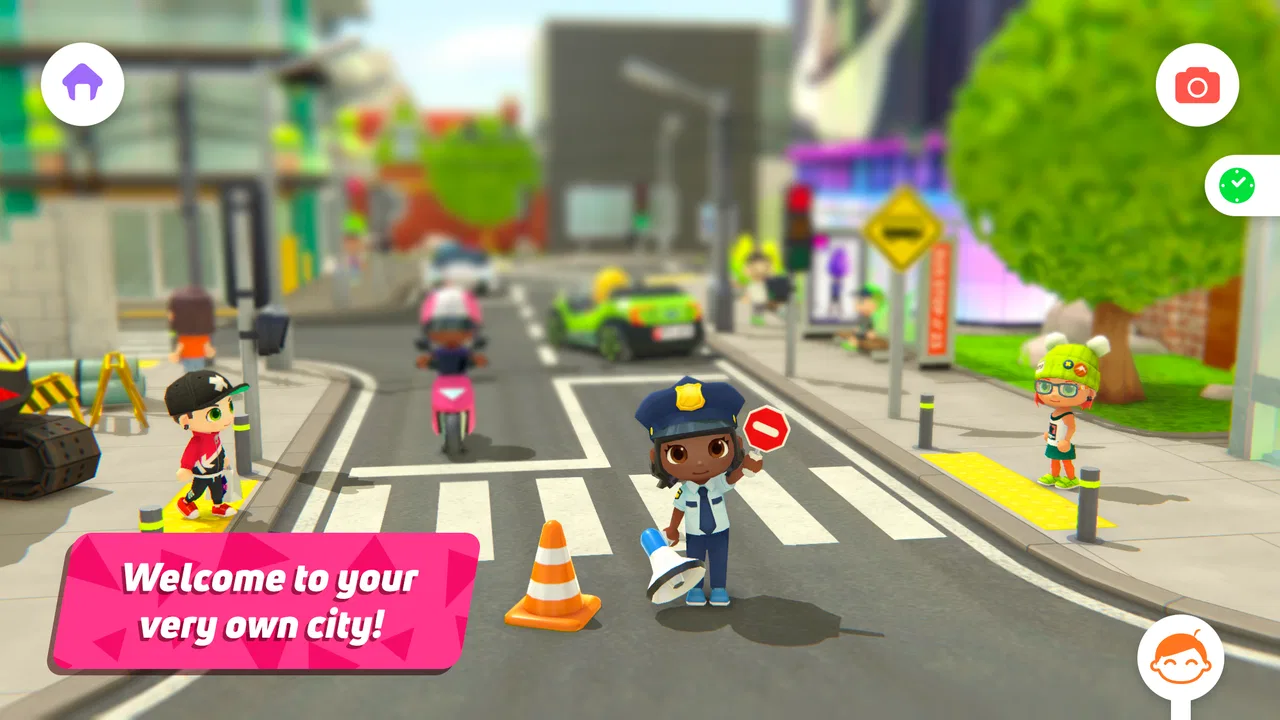
I spent time with Urban City Stories: World Game as a relaxed educational roleplay game, and its appeal became clear quite quickly: it gives me a city-shaped playground where I can make up situations instead of chasing a strict score. The setting invites me to move between shops, homes, and streets, then turn those places into the backdrop for my own small stories. It feels closer to imaginative play than to a conventional game with a fixed route.
That distinction matters. I would not choose this title when I want demanding puzzles, fast reactions, or a clearly defined campaign. I would choose it when I want an open-ended activity that can entertain a child, encourage pretend play, or give me a quiet few minutes of creative exploration. The educational label fits best through roleplay, observation, and decision-making rather than through lessons presented like schoolwork.
How the city gives play a starting point
The first goals are deliberately simple. I can enter a location, look around, move between familiar urban spaces, and begin assigning meaning to what I see. A shop can become the setting for a buying-and-selling story, a home can become a family scene, and a street can connect separate parts of an imagined day. The game does not need to explain a complicated objective before I can start playing, which makes the opening approachable for younger users.
You May Also Like

 Blood Strike: 2.5 Anniversary
Blood Strike’s Loadouts Turn Every Drop Into a Tactical Gamble
A close look at Blood Strike’s custom loadouts: how fast access to signature weapons reshapes its battle royale rhythm, rewards preparation, and narrows the gap between fights.

 Pandora - Music & Podcasts
Pandora’s Music Is Easy to Start, but Harder to Recover
Pandora’s strength is its low-effort path from a seed to a station. Its weak spot is how much confidence it asks you to place in connection, setup, and quiet recovery.

 8 Ball Pool
 Is Built on Rivalries, Rematches, and Routine
A close look at the rivalries, rematches, shared routines, and unanswered safety questions that turn a quick pool match into a persistent mobile community.

 Samsung Music
’s Quiet Strength Is Playing What You Already Own
Its reach comes less from spectacle than from dependable access to a personal library. That simplicity is both the app’s strongest retention engine and its ceiling.

 AccuWeather: Weather Radar
AccuWeather Review: A Quick, Clear Forecast for Everyday Decisions
For everyday plans, the best forecast is the one you can understand quickly. AccuWeather makes rain timing, radar, and local conditions easy to act on, with a few trade-offs.

 Hill Climb Racing
Why Hill Climb Racing Still Turns Crashes Into One More Run
A tiny car, a bumpy hill and one more upgrade: Hill Climb Racing keeps resurfacing because its simple chaos makes every near-miss feel personal.
More From Our News Desk



That simplicity is also the first trade-off. Players who expect missions, rewards, or a visible checklist may wonder what they are supposed to complete. My early sessions worked better when I treated the city as a box of props rather than as a sequence of tasks. I made up a reason to visit one place, moved to another, and let the next scene grow from the previous one. The game provides the setting; the player supplies much of the direction.
For a child, that can be a strength because there is room to choose. Instead of being told that there is only one correct action, the player can explore different social situations through pretend play. A parent can also use a location as a conversation prompt: ask what might happen in a shop, who lives in a home, or why someone is walking along the street. In that sense, the game can support language practice and storytelling without turning every interaction into a test.
One useful way to begin is to create a small routine rather than opening the entire city without a plan. I might start at home, decide who is leaving, visit a shop, and finish the scene back at home. This gives a young player a beginning, middle, and end while preserving the freedom that makes the game enjoyable. It also prevents the first session from becoming aimless wandering.
The absence of pressure makes the game friendly for casual use. I can put it down without feeling that I have lost progress in a competitive sense, then return later and invent a different scenario. That is valuable for family play, waiting rooms, or a short break. It is less satisfying for anyone who measures enjoyment through completed stages and increasingly difficult objectives.
Progress that comes from imagination
Urban City Stories does not make progress feel like a traditional level-based climb in my experience. The clearest progress signal is my growing familiarity with the city and my ability to create more involved scenes. At first, I may simply move between places. Later, I can connect those locations into a longer story with several characters, errands, and changes of setting.
This kind of progress is personal rather than numerical. I notice it when I stop asking what the game wants me to do and start using the environment with a specific idea in mind. A child may begin by repeating the same movement, then gradually create a pretend shopping trip or a household routine. The game’s value increases when the player learns to see the locations as parts of a story rather than isolated screens.
That also explains why the title can feel different on a second or third visit. A fixed puzzle usually gives me the same problem again, while a roleplay space changes according to the scenario I bring into it. The city itself may not need to transform for the play session to feel different; the imagined purpose does that work. For families, this makes it possible to reuse the game as a storytelling prompt instead of treating it as a one-time activity.
I would still set expectations carefully. The game is not the best fit for a player who needs a strong unlock structure to stay interested. If visible rewards and new abilities are the main reason someone plays, an educational puzzle game or a structured adventure may provide a clearer sense of advancement. Here, the reward is mostly the scene I create and the freedom to reshape it.
A practical tip is to give the player a theme before starting. “Prepare for a busy day,” “run a shop,” or “show a visitor around town” creates an immediate objective without forcing the game into a rigid mission format. I found that this small prompt makes the open-ended design feel more purposeful, especially for a child who is still learning how to turn free exploration into a complete story.
Challenge and the deliberately gentle curve
The difficulty curve is gentle because the main challenge is not reflex, timing, or problem-solving under pressure. The game asks more from imagination than from coordination. That makes it accessible to the Everyone age group and suitable for players who may be uncomfortable with games that punish mistakes or demand quick responses.
In a normal adventure, I expect obstacles to become harder, enemies to gain strength, or puzzles to require more complex solutions. Urban City Stories takes a different path. Its challenge grows when I choose to make the scenario more detailed. A simple visit can become a multi-stop story, and a single character can become part of a larger group. The player controls the intensity.
That player-controlled difficulty is useful in mixed-age households. A younger child can focus on moving characters and recognizing places, while an older child can develop a longer narrative around the same setting. An adult can join without taking over the experience, perhaps by asking questions that encourage the child to explain what is happening. The game works best when the adult acts as a collaborator rather than as someone searching for hidden objectives.
The downside is that there may be no natural push to become more skilled. If I am not in the mood to invent a scenario, the same freedom that normally feels welcoming can feel empty. This is where the game differs sharply from educational titles built around spelling, arithmetic, memory, or logic. Those alternatives provide a clear answer and a measurable challenge; this one provides a place to practice expression and imagination.
I also would not present it as a substitute for a curriculum-based learning app. Its educational value comes from how the player uses the city, so the result depends on age, attention, and the quality of the roleplay. For a child who enjoys pretend play, that flexibility can be more engaging than a worksheet-style activity. For a child who needs direct instruction, a focused learning app will probably be more effective.
What keeps the game in rotation
The strongest retention feature is replayability through new stories. I can revisit the same urban spaces and assign them a different purpose each time. One session might center on a household routine, another on a trip through the shops, and another on a character moving through the streets. The game does not have to surprise me with a new challenge for the play to change.
That approach creates gentle retention rather than pressure. I do not feel pushed by timers, competition, or a need to maintain a streak. For children, this can make the experience calmer than many free games. For parents, it means the title is less likely to turn a short activity into a stressful demand for constant performance.
There is, however, a retention limit. Open-ended play depends on the player’s willingness to invent. Once I have exhausted the obvious scenarios, I need to bring fresh ideas myself. This is why prompts are so useful. A parent can suggest a weather-themed day, a visitor arriving in town, or a character with several errands. Even a simple change in the order of locations can make the session feel newly organized.
The free entry point helps with trying the game. It is available at no purchase price, while optional in-app purchases are listed at around four and a half dollars per item. I would approach those purchases thoughtfully rather than assuming they are necessary for everyone. A child may ask for them because something looks appealing, but the best decision depends on whether the added content genuinely expands the kind of play your family wants.
For a shared device, I would establish a simple rule before handing it over: explore the available experience first, then discuss any purchase together. This is especially important because the game is aimed at Everyone, which means younger players may be using it without understanding that an in-game item can involve real money. The title is more enjoyable when the creative play, not the purchase prompt, remains the center of attention.
Another realistic use case is a short transition between activities. After school, a child could use the city to act out a familiar routine before moving on to dinner or homework. The roleplay can help turn an ordinary event into a small narrative, but I would still set a clear stopping point because the open format does not naturally announce when a session is complete.
Who will enjoy it, and who should choose something else
I recommend Urban City Stories most readily to children who already enjoy dolls, toy towns, pretend shops, and making up conversations. It is also a good option for parents looking for a shared activity that encourages talking rather than simply watching. The city setting gives adults enough recognizable context to participate: ask where a character is going, what they need, or what should happen next.
It can also suit older players who like casual creative games and do not need a win condition. I enjoyed it more when I treated it as a digital stage than when I searched for a conventional progression system. That mindset turns the lack of pressure into a benefit. The game gives me room to pause, change direction, and restart a scene without penalty.
I would skip it if my priority were academic drills, a deep management simulation, or an adventure with a demanding difficulty curve. It is also a weaker choice for players who lose interest without frequent unlocks or explicit milestones. A puzzle game will usually offer more satisfying feedback for someone who wants to improve at a defined skill, while a story-driven adventure will offer stronger narrative direction.
The developer is SUBARA, and the game has built a sizable audience, with more than fifty million installs and an average rating of four and a half from roughly two hundred thousand ratings. Those figures suggest that the open-ended city concept has broad appeal, but they should not replace a look at your own play style. Popularity cannot make a freeform game feel structured if structure is what you want.
On compatibility, the current version is 1.7.0 and requires Android 7.0 or later. That makes checking the device’s operating system a sensible step before installing. The game is free to start, carries an Everyone rating, and includes optional purchases priced at around four and a half dollars per item. I would describe it as easy to try, but worth introducing with realistic expectations about its creative rather than mission-based design.
My verdict on the progression design
Urban City Stories succeeds when its open city is treated as a tool for roleplay. The early goals are easy to understand, the progress signals come from becoming more inventive, and the difficulty stays gentle enough for a broad audience. Its replay value comes from changing the story rather than climbing a demanding ladder of levels or unlocks.
That is both its identity and its main limitation. I found the freedom welcoming, but I also had to supply the momentum. A child who loves imaginative play may return repeatedly with new scenarios, while a player who needs constant rewards may move on quickly. The game does not solve that difference; it makes the player’s preferred style especially visible.
My best recommendation is to use it actively rather than passively. Start with a small story, connect two or three locations, and let the player decide what happens next. For family use, add questions instead of instructions. For independent play, offer a theme when the city feels too open. Those habits turn a loose playground into a more satisfying creative routine.
In the end, I see this as a calm, accessible educational roleplay game rather than a conventional challenge-based title. If that sounds like the kind of experience you want, Urban City Stories is easy to try and offers a friendly setting for everyday storytelling. If you need clear goals, measurable skill-building, or a strong unlock cycle, I would choose a more structured alternative instead. Its progression verdict is therefore positive but specific: the game sustains play through imagination and flexible scenarios, not through escalating difficulty.
FAQs for Urban City Stories: World Game
01What is Urban City Stories: World Game?
Urban City Stories: World Game is a family-friendly life simulation game where players can explore a colorful city, visit different locations, create stories, and interact with characters. Instead of following one fixed objective, you can decide how to spend your time, whether that means visiting homes, shops, schools, or other city areas and inventing your own everyday adventures.
02Is Urban City Stories: World Game suitable for children?
The game is designed with a bright, cartoon-style presentation and simple interactions that make it accessible to younger players. However, parents should still review the available content and device settings before allowing children to play. As with many mobile games, it is also worth checking advertising, in-app purchase, privacy, and parental-control options through the relevant app store.
03Does the game require an internet connection?
Urban City Stories: World Game may allow much of its basic gameplay to be enjoyed offline after installation, but some features can depend on an internet connection. Online access may be needed for downloading updates, restoring purchases, loading promotional content, or accessing certain services. For the most reliable experience, install the latest version and check the store listing for current connectivity requirements.
04Is Urban City Stories: World Game free to download?
The game can generally be downloaded without an upfront purchase, but free access does not necessarily mean that every location, character, or feature is available immediately. Optional purchases, advertisements, or premium content may be included depending on the platform and current version. Before downloading, review the app-store pricing details and configure purchase restrictions if children use the device.
05What can players do in Urban City Stories: World Game?
Players can explore an open-ended city environment, move between different buildings and areas, interact with characters and objects, and create their own scenarios. The appeal comes from experimentation rather than competition: you can role-play daily activities, arrange characters, discover interactive elements, and build short stories at your own pace. It is best suited to creative, relaxed play rather than challenge-focused gaming.
Pros
- Open-ended play encourages creativity and imaginative storytelling.
- Bright
- friendly visuals are appealing to younger players.
- Multiple locations offer variety beyond a single home setting.
- Simple controls are easy for children to understand.
- Characters and objects can be freely arranged for role-play scenarios.
Cons
- Some areas or items may require additional purchases to access.
- Gameplay can feel repetitive once the main locations are explored.
- Limited objectives may not satisfy players seeking structured challenges.
- Performance may vary on older phones and tablets.
- Frequent prompts for other apps or purchases can interrupt play.

Urban City Stories: World Game
Gallery